Home / Gold Coast Mansions / Partial remains
Rosemary Farm
Roland R. Conklin estate, Conklin estate
Partial remains Lloyd Harbor (West Neck), Suffolk County for Roland Ray Conklin
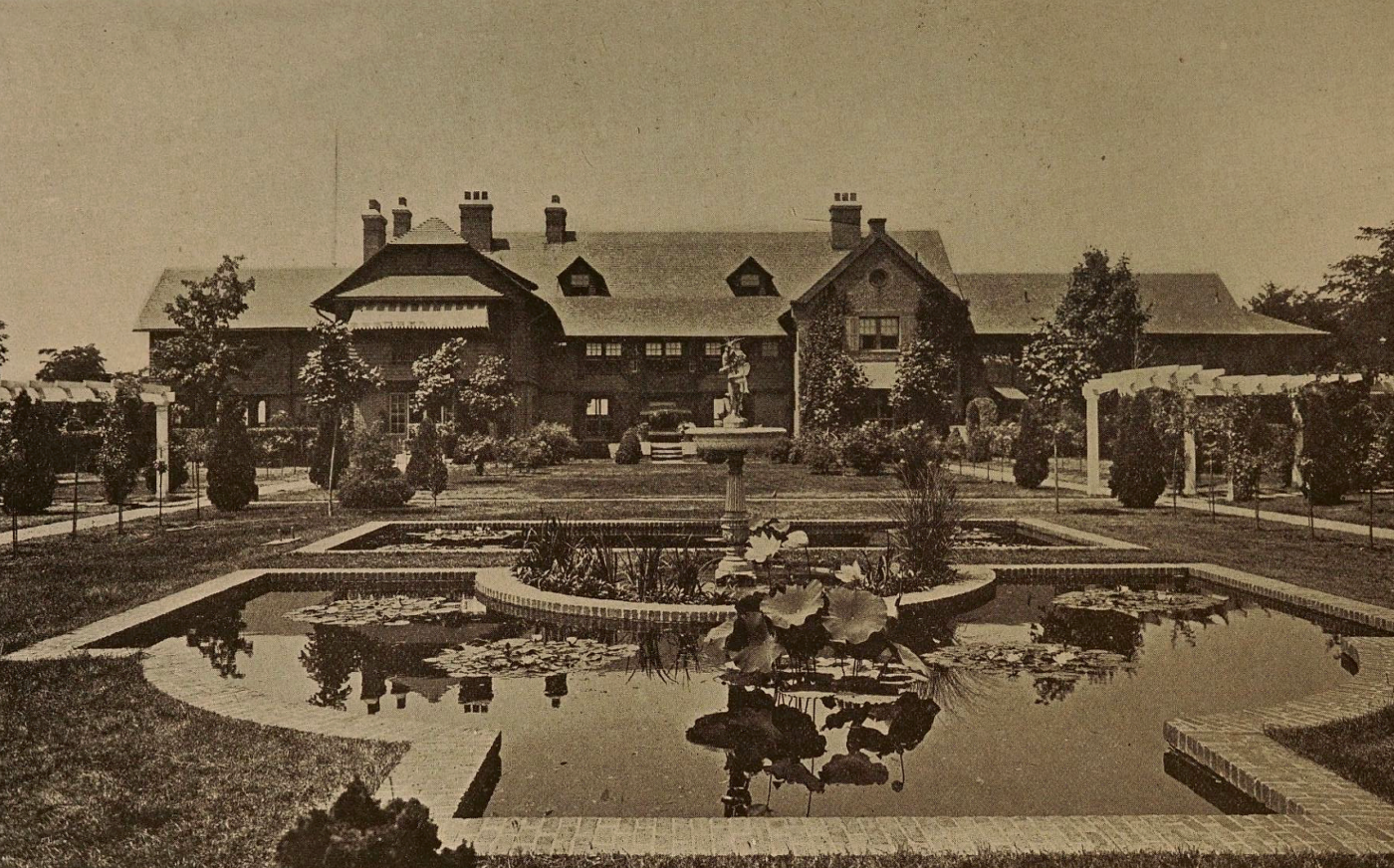
Roland Ray Conklin (1858 to 1938) was born in Huntington, a descendant of John Conklin, who settled there in 1653. According to the Huntington Historical Society, he built a real estate business in the Midwest, reorganized it in New York as the North American Trust Company after the panic of 1893, and later helped found the National Bank of Cuba and the Havana Telephone Company. After his marriage to Mary Macfadden, a former opera singer, he returned to Huntington and bought land on West Neck.
The society reports that Conklin hired the architect Wilson Eyre in 1907. The Architectural Record published the finished house in October 1910. It described an estate of 350 acres with farm buildings, a house on the highest knoll reached by a winding drive a third of a mile long, lower walls of brick, upper walls hung with tile, and a roof of red and brown tiles. The magazine credited Eyre with the house, the gardens and the interior details, noted carving by Edouard Meane, and described a music room with a raised stage for private theatricals. Other sources give a smaller acreage and a later date for the house.
The estate's most unusual feature was an outdoor amphitheater set into the wooded hill south of the house. The Historical Society attributes its design to the Olmsted Brothers firm and says it seated more than 3,000 people on terraces around a central moat. John Barrymore and Sarah Bernhardt are reported to have performed there. In 1917 it held the National Red Cross Pageant, a war bond event with more than 500 performers that was filmed and released in December 1917. No copy of the film is known to survive.
After Mary Conklin's death the estate was sold in 1924 to the Diocese of Brooklyn, now the Diocese of Rockville Centre. The Seminary of the Immaculate Conception opened on the grounds on September 28, 1930. The Conklin house served for a time as a retreat center and as housing for nuns, then stood empty because the seminary could not afford to bring it up to fire code. It was vandalized and burned in 1990. Volunteers partly restored the amphitheater in 1987, and it has since been restored again to grass terraces with stone steps and arches.
Under a three-way agreement announced in 2023, the seminary, the Village of Lloyd Harbor and New York State divided about 216 acres. The state acquired 180 acres as an addition to Caumsett State Historic Park Preserve, using nearly $18 million from the Environmental Protection Fund. The village agreed to buy about 20 acres containing the amphitheater and barn, and the seminary kept 16 acres as a retreat and conference center. The state says the new parkland will offer trails. Whether visitors may enter the amphitheater was not established.
Sources
- Huntington Historical Society: Former Conklin Amphitheater On Seminary Land Restored
- Internet Archive: The Architectural Record, vol. 28 (October 1910): 'Rosemary Farm,' the Residence of Roland R. Conklin, Esq., Wilson Eyre, Architect
- North Shore Land Alliance: A Very Big Deal (Seminary of the Immaculate Conception)
- The Leader (Lally Communications): Lloyd Harbor Seminary Grounds Saved
- New York State Governor's Press Office: Governor Hochul Announces 180-Acre Expansion of Caumsett State Historic Park Preserve on Long Island
- Wikipedia: Caumsett State Historic Park Preserve
- GCatholic: Immaculate Conception Seminary, Huntington, New York
Last updated October 18, 2026. Something wrong or missing? Tell us.