The lost Gold Coast Mansions
Of the several hundred Gold Coast Mansions built on the North Shore between the 1890s and 1930, most are gone. Some burned, some were taken down for taxes, some made way for subdivisions. This is the record of the ones we know.
-
Brookholt
Brookholt was the East Meadow country house of Oliver Hazard Perry Belmont and his wife Alva, the former Mrs. William K. Vanderbilt. Richard Howland Hunt designed the Colonial Revival house in about 1897. Belmont died there.
-
Beacon Towers
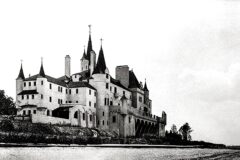
Beacon Towers was a white stucco castle on the shore at Sands Point, built in 1917 and 1918 for Alva Belmont, the suffrage leader and former wife of William K. Vanderbilt. The firm of Hunt and.
-
Harbor Hill
Harbor Hill was the Roslyn estate of Clarence H. Mackay, heir to a Comstock silver fortune and a leader in the telegraph business. Stanford White of McKim, Mead and White designed the French Baroque house in.
-
Knollwood
Knollwood was a 60-room granite country house in Muttontown built for the New York stockbroker Charles I. Hudson. The firm of Hiss and Weekes designed it, and sources date the work between 1906 and 1920. King.
-
Meudon
Meudon was the Lattingtown estate of the New York lawyer William Dameron Guthrie. C. P. H. Gilbert designed the 80-room Renaissance Revival house, completed in 1900 and named for the Chateau de Meudon near Paris. The.
-
Farnsworth
Farnsworth was the Long Island country house of C. K. G. Billings, a Chicago industrialist and horseman, in the area now usually called Matinecock near Locust Valley. Guy Lowell designed the brick Georgian Revival house around.
-
Pembroke
Pembroke was the Glen Cove estate of Captain Joseph Raphael De Lamar, a Dutch-born mining financier. C. P. H. Gilbert designed the house, which the Glen Cove Public Library says was begun in 1914 and took.
-
Ferguson’s Castle
Ferguson's Castle, first called The Monastery, was the hillside home of Juliana Armour Ferguson above Huntington Harbor in what is now the Village of Huntington Bay. Architect Allen W. Jackson designed a concrete house with red.
-
Matinecock Point
Matinecock Point was the country house of J. P. Morgan Jr. on East Island in Glen Cove. Christopher Grant La Farge designed the Georgian Revival house, which was finished in about 1913. In 1915 an intruder.
-
Rosemary Farm
Rosemary Farm was the West Neck estate of the banker Roland Ray Conklin and his wife, Mary Macfadden Conklin, in what is now Lloyd Harbor. Wilson Eyre designed the brick and tile house, which The Architectural.
-
Land’s End
Lands End was a Colonial Revival house at the northern tip of Sands Point, built about 1900 to 1902 and best known as the home of Herbert Bayard Swope, executive editor of the New York World..
-
Inisfada
Inisfada was a Tudor Revival mansion in North Hills, built from 1916 to 1920 for Nicholas and Genevieve Brady to designs by the Philadelphia architect John T. Windrim. In 1937 it passed to the Jesuits, who.
-
Laurelton Hall
Laurelton Hall was the country estate of the artist Louis Comfort Tiffany above Cold Spring Harbor, in what is now the Village of Laurel Hollow. Tiffany built the 84-room house between 1902 and 1905 on about.
-
The Whitney estate
William Collins Whitney, a financier and former Secretary of the Navy, assembled a 530-acre estate at Old Westbury, in the area then called Wheatley, and had McKim, Mead & White design a country house there between.